
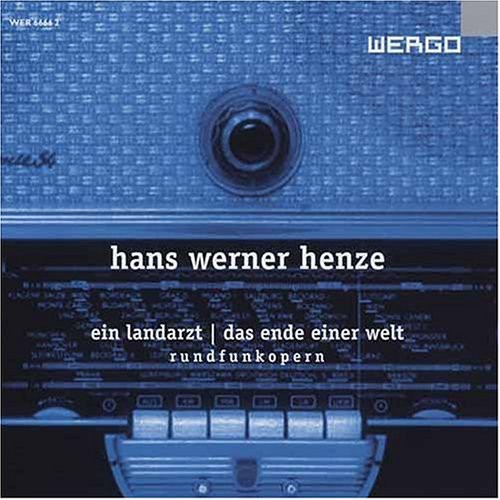
Ein Landarzt/Das Ende Einer Welt - CD
by Henze, Wdr So, H. W. Henze
$20.99
$26.99
-22%Quantity
01
Pay over time for orders over $35.00 with
Offers & Perks
Earn 20 points with this purchase
Added to your rewards balance after checkout.
100 points welcome bonus
Create an account and start with extra points.
Availability:In StockArtists:Henze, Wdr So, H. W. HenzeGenre:Classical, Opera/OperettaRelease date:10/11/2005Original year:2005
Publisher:Wergo GermanyLabel:Wergo GermanyUPC:4010228666625Weight:0.32Discs:2Product ID:SCDB58WJRF
In the beginning of the 1950s, Hans Werner Henze wrote two radio operas for the former North West German Radio. The genre was developed around the 1930s and means a form of opera without any visual elements and hence without a stage. Under such circumstances the plot has to reach the listeners' ears by other means - by making the text exceptionally easy to follow, and by means of acoustic special effects like echo or sound collages. With this CD, WERGO publishes the première of the revised versions on Sept. 27, 1996, in the Philharmonie in Cologne: Franz Kafka's oppressive surrealism in "Ein Landarzt" (A Country Doctor) and Wolfgang Hildesheimer's scathing satire in "Das Ende einer Welt" (The End of a World). In "Das Ende einer Welt", Henze himself took the role of the narrator, which underlines how topical the subject matter of this work remains for him.On the occasion of the première of the revised versions of these two operas the composer wrote of the "inner connection" between the works: "There is, first, the state of a man who has taken leave of his senses, of being exposed, of the most terrible isolation, as if 'ordered' by invisible powers acting on a 'higher level.' There is talk of deception, of self-deception, of deceiving and being deceived, of the volatility and unreliability of life matters, beginning with the most simple (or most banal) and ending with the metaphysical and the grotesque." It is also conceivable that the increasing disquiet that took hold of Henze in the early fifties with regard to an evolving society that nonetheless remained the same at it's core ("Everywhere the old was not yet old enough, while the new pointed to a future that did not look very promising, " wrote the composer in his essay "Nach dem Krieg" [After the war]) took musical form in his two radio operas: on the one hand, a nightmare vision of horror; on the other, a cynical farce.
Publisher:Wergo GermanyLabel:Wergo GermanyUPC:4010228666625Weight:0.32Discs:2Product ID:SCDB58WJRF
Publisher: Wergo Germany
Label: Wergo Germany
Artist(s)
Free shipping on orders over $75. Standard shipping takes 3-7 business days. Eligible items may be returned within 30 days of delivery. Conditions apply.