Sale 10% Off Your First Order

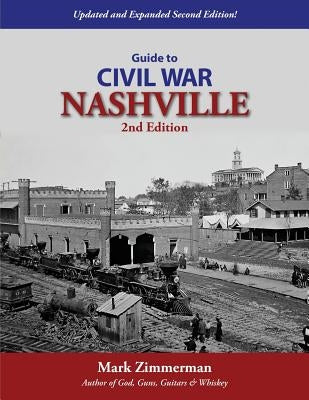
Guide to Civil War Nashville (2nd Edition) delivers a detailed 50-mile tour of 25 historical sites that defined the Battle of Nashville and the Union occupation of Tennessee's capital. This extensively researched guidebook combines modern and wartime photographs, touring and battle maps, diagrams, and precise GPS coordinates to help history enthusiasts navigate Civil War landmarks throughout Nashville.
The guide explores the fall of the river forts and the capture of Nashville by Union forces in February 1862, which prompted the Great Panic. Detailed coverage includes the role of river transports and the military railroad system, along with the controversies of Federal occupation. A historical map of Nashville in 1864 displays the city's infrastructure during wartime.
A lengthy article examines the decisive 1864 Battle of Nashville, the last major military activity in the Western Theater. Another article covers the skirmish on the Cumberland River between Federal gunboats and Confederate cavalry prior to the main battle. Four detailed maps, designed in coordination with Battle of Nashville Preservation Society Historian Ross Massey, illustrate troop movements for both days of the battle.
Fort Negley, the pride of Federal engineers and the largest stone fortification built during the war, is featured as a major tourism site with interpretive ruins. The tour includes three historic cemeteries with complete burial site maps, and three antebellum plantation mansions: Belmont, Travellers Rest, and Belle Meade, all renovated and open to the public.
The Tennessee State Capitol complex, built immediately before the war, and the Tennessee State Museum are thoroughly examined. Four extant churches on the tour served as military hospitals during the fighting. The tour encompasses a dozen battle sites, including the famous Shy's Hill (known as Compton's Hill during the battle).
All sites on the tour include original photographs. The guidebook provides precise driving directions with GPS coordinates, historical-marker text and locations, illustrated orders of battle, and Medal of Honor recipients. Additional resources include a timeline and map of military operations, pages on Fortress Rosecrans and Fort Granger, a listing of other Civil War sites in Middle Tennessee, and a comprehensive bibliography.
The guide explores the plight of citizens living under military occupation and Nashville's wartime role as a strategic Union stronghold. This fact-packed resource serves as an essential companion for anyone interested in Civil War history, battlefield tourism, or Tennessee's role in the conflict.